

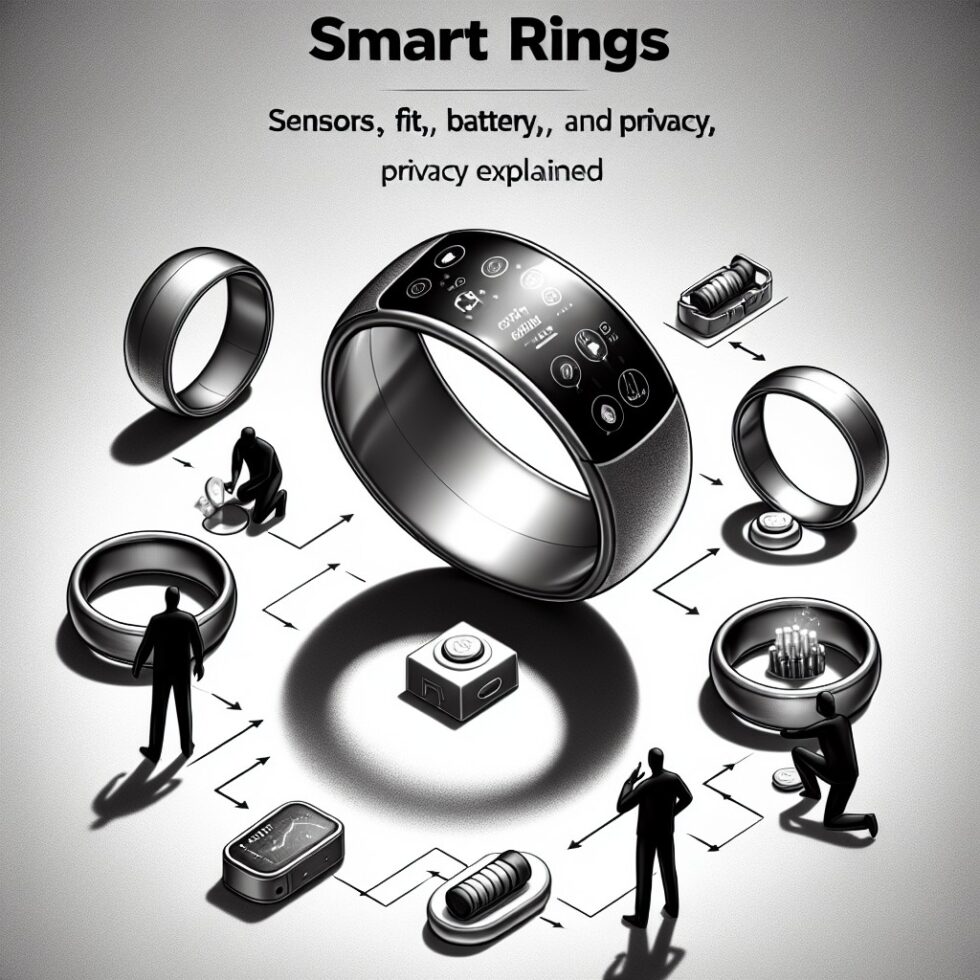
Why Smart Rings Are Getting So Much Attention
Smart rings are moving from novelty to useful daily tools. They pack meaningful sensors into a small, comfortable form factor that blends in at work, at the gym, and even at formal events. If watches feel bulky, and bands look out of place, rings offer an alternative: quiet, always-on sensing with better comfort for sleep and round-the-clock wear.
This guide explains what a smart ring truly is, the signals it can capture reliably, where expectations should be set, and how to choose and care for one. We’ll also cover privacy and data choices, plus a few advanced use cases like gesture control and contactless access.
What a Smart Ring Actually Contains
Under the metal or ceramic exterior is a tight stack of parts that work together within severe size and power limits. Knowing the basics helps you judge marketing claims and pick a ring that fits your goals.
Core Sensors
- PPG optical heart sensors. Photoplethysmography uses LEDs (often green, red, and infrared) and a photodiode to detect blood volume changes in your finger. It enables heart rate, heart rate variability (HRV) during rest, and sometimes estimated blood oxygen saturation (SpO2). IR and red light penetrate deeper and can help in darker skin tones; green often works best for motion-rich activity.
- Motion sensors. A 3-axis accelerometer (and sometimes a gyroscope) captures steps, sleep movement, and gestures. Motion also helps algorithms filter out noise in the optical signal.
- Skin or ambient temperature. Temperature sensors track trends overnight, which can be useful for recovery status and cycle tracking. Rings rarely measure core body temperature directly; they infer trends against your typical baseline.
- Optional EDA or skin conductance. Some rings add electrodermal activity sensing. It can help with stress-related features, though interpretation is still evolving and motion can confound it.
Radio and Compute
- Bluetooth Low Energy (BLE). The ring syncs to your phone and sometimes to optional chargers or cases that act as relays. BLE 5.x keeps power draw low with short, bursty transfers rather than long connections.
- Microcontroller and memory. A tiny microcontroller schedules sampling, filters raw data, and buffers it locally. Short onboard storage means you can leave your phone behind for a while, but not for days.
- Secure element (sometimes). For rings that support payments or secure access, a separate chip can store cryptographic keys and handle sensitive operations.
- NFC (optional). Some models embed NFC for contactless payments or door access. This is a different radio than BLE and is powered in close proximity to a reader.
Battery and Charging
- Miniature lithium polymer cell. Capacities are tight. The ring’s shape limits battery volume, so firmware efficiency matters as much as battery mAh.
- Charging cradle or wireless dock. Contacts or inductive charging top up the ring in about an hour or two. Heat is the battery’s enemy; avoid charging on a hot surface or under direct sun.
- Water and dust resistance. Look for an IP rating. IP68 or higher usually means safe for showers and swimming, but check your model’s swim suitability and depth rating before diving in.
Materials and Comfort
- Titanium or ceramic bodies resist scratches, weigh little, and feel comfortable for sleep. Rounded inner edges and a slightly oblong interior can help stabilize sensors.
- Coatings and colors affect scratch visibility. Polished finishes hide micro-scratches better; matte finishes can highlight wear.
- Inner sensor windows need skin contact. A ring that spins or gaps will degrade signal quality.
What Rings Measure Well—and Where to Keep Perspective
Rings excel at rest-centric insights. They’re most accurate when you’re still: while sleeping, reading, or sitting. During intense motion, any optical system on the finger struggles more than one that straps tight to the wrist or arm.
Metrics You Can Usually Trust
- Nighttime resting heart rate and HRV trends: These are solid for tracking recovery, strain, and stress patterns. The finger offers good perfusion with less pressure variation than a sliding wristband.
- Sleep timing and duration: Bedtime, wake time, and total sleep are generally reliable, especially after the ring learns your typical schedule.
- Temperature trends: Not absolute body temperature, but relative changes from your baseline. Useful for early signs of illness or travel-related circadian shifts.
- Basic activity volume: Step counts and general movement levels are fine for day-to-day tracking, though they are estimates.
Metrics to Treat as Estimates
- Calories burned: These are rough across all wearables unless paired with lab-grade testing. Use them as a relative gauge, not absolute truth.
- Detailed sleep stages: Light, deep, and REM breakdowns are improving but not clinical-grade. They’re most useful for long-term patterns rather than single-night judgments.
- SpO2 on the finger: Overnight trends are plausible in still conditions, but motion and skin differences can affect readings. Rings are helpful for patterns, not diagnosis.
- Arrhythmia detection: Some claims are emerging, but even the best consumer wearables are conservative here. Consult a clinician if you have any concerns about palpitations or irregular rhythm.
Common Sources of Error
- Motion artifacts: Weightlifting, rowing, and high-impact exercise can disrupt the optical signal. Tight but comfortable fit reduces this problem.
- Fit and rotation: If the sensor window rotates to the side or the ring sits loose, contact degrades and readings drift.
- Skin and environment: Very cold fingers, tattoos on the finger, or heavy lotions can interfere with light absorption and reflection.
- Firmware modes: Some rings reduce sampling to save power. If you want more precision for a period, switch to a higher sampling mode and accept shorter battery life.
Fit and Sizing: The Make-or-Break Step
Getting the size right is crucial. Unlike a watch band, a ring doesn’t have a quick adjustment, and fingers swell or shrink with temperature, hydration, and time of day.
How to Size With Fewer Surprises
- Use a sizing kit if available. Wear your trial ring for several days. Test in the morning (larger finger), mid-day, and evening (medium to smaller finger).
- Choose the non-dominant hand. The index and middle fingers are common choices. They usually have better blood flow than the ring finger and less motion than the thumb.
- Find the happy medium: Slight resistance when sliding over the knuckle, but no pinching during warm afternoons or exercise.
- Check sensor alignment: Some rings prefer a specific orientation. If yours does, mark the inner band so you can align by feel when in a hurry.
Battery Life, Charging Habits, and Longevity
Battery life varies from three to seven days depending on sensor use and sync frequency. Most people charge during a shower or while making coffee, a few times per week.
Habits That Extend Life
- Partial charges are fine. Modern lithium chemistries tolerate top-ups. Avoid running to 0% or staying at 100% for days.
- Keep it cool. Heat ages batteries. Don’t charge in a hot car or on a sunny windowsill. If your charger gets warm, place it on a ceramic or metal surface.
- Disable what you don’t need. If you’re not using SpO2 or constant high-rate HR logging, turn them off except when needed.
- Update firmware. Power optimizations often arrive after launch. Keep the companion app and ring firmware current.
Expectations Over Years
Expect some capacity loss after a year or two. If your ring supports battery health reports, check them quarterly. Rings with replaceable batteries are rare; most rely on manufacturer refurb programs. Plan for a typical lifespan similar to other small wearables.
Privacy and Data Choices: You Remain in Control
Smart rings gather intimate health-adjacent data. Treat this data with the same care you’d give your medical notes. The smartest habit is to decide what you want the ring to know—and what you’re comfortable sharing.
Decisions to Make Up Front
- Cloud vs. local. Some analytics may require cloud processing for advanced features. If the ring offers a local-only mode, try it first. You may gain enough insight without sending raw data anywhere.
- Data export and deletion. Check whether you can export raw or processed data (CSV or JSON) and whether you can delete your account and associated data fully.
- Health data integrations. Decide if you want to sync with Apple Health or Health Connect. Aggregation can be convenient, but it broadens where your data lives.
- Sharing and social features. Disable leaderboards or friend sharing if you don’t want activity data visible to others, even indirectly.
Understanding Claims and Labels
- Wellness vs. medical. Most rings are regulated as wellness devices. They provide trends and insights, not diagnoses. Look for clear labeling; if a feature claims to detect a condition, verify the regulatory status in your country.
- Encryption in transit and at rest. Nearly all vendors tout encryption. Confirm if keys are stored in a secure element and if data is encrypted on-device or only in the cloud.
- Retention and third-party use. Read the privacy policy for data retention periods and whether de-identified data is shared with partners. You can vote with your wallet for vendors who allow opt-in only.
Use Cases That Stick Beyond the First Month
The real test is whether the ring keeps delivering value after the novelty fades. Focus on one or two outcomes that matter to you and build small, repeatable habits.
Recovery and Performance
- Training load guidance: Use resting HR and HRV trends to plan lighter sessions after heavy days or poor sleep.
- Travel adjustments: Track temperature and sleep drift after crossing time zones. Shift bedtime and light exposure with concrete targets.
- Breathwork and breaks: Set prompts when the ring flags elevated resting heart rate or low HRV.
Sleep Quality Over Time
- Quiet the late hours: Aim for consistent pre-bed routines. Evaluate how caffeine, heavy meals, or screens affect your actual sleep duration.
- Selective staging review: Don’t obsess over last night’s stage chart. Look for weekly patterns instead, like “deep sleep tends to improve after afternoon workouts.”
Cycle Awareness and Wellness
- Trend, not instant prediction: Temperature shifts help identify phases over multiple cycles. Treat single-day outliers cautiously.
- Plan recovery windows: Adjust training, sleep goals, or travel schedules around known phases to maintain consistency.
Quiet Notifications and Alarms
- Silent cues: Haptic rings are rare, but some support gentle notifications via the phone only during set windows, so your sleep and work stays undisturbed.
- Smart alarms: If offered, try wake windows that nudge you when you’re already in lighter sleep.
Payments, Access, and Gesture Control
Not all rings do this, but if you’re curious, here’s what to know.
Contactless Payments
- Tokenized payments via NFC: Rings can store a payment token with your card issuer. It’s not your actual card number and is useless without the ring.
- Bank and network support varies: Check issuer compatibility and regional availability. Expect limited support compared to phones and watches.
- Waterproof taps: Many payment rings are fully waterproof and great for the beach or pool, where you might not carry a wallet or phone.
Secure Access
- Doors and lockers: Some smart locks, campus systems, and gyms support NFC credentials. Rings can be more convenient than badges you forget.
- Device unlock: A few ecosystems let wearables keep devices unlocked when nearby. Confirm the security model and fallbacks before relying on it.
Gesture Input
- Presentation controls and simple gestures: Double-taps, flicks, or rotations can advance slides or toggle lights. Gestures draw more power, so expect shorter battery life when active.
- AR and media control: Rings can act as subtle remotes for headsets or TVs. Latency and false positives vary by vendor; test before committing to a workflow.
Buying Guide: What to Look For
Before you buy, align features with your priorities. A great ring for sleep may not be the best for gestures or payments.
- Sizing kit availability: Non-negotiable if you haven’t worn a smart ring before.
- Battery life: Match to your charging habits. If you dislike frequent charging, avoid features you don’t need.
- Sensor set: PPG + accelerometer is standard. Only pay for EDA or SpO2 if you’ll use them.
- Water rating: Check IP and swim rating if you plan to wear it everywhere.
- Data policy and exports: Prefer vendors with transparent retention and easy export/delete.
- Platform integrations: Confirm compatibility with your phone OS and health data systems.
- NFC features: If you want payments or access, verify bank and lock compatibility by country.
- Materials and finish: Consider scratch resistance and how the finish will age with daily wear.
- Warranty and support: Look for repair or replacement options if the battery fades early.
Setup Tips and Ongoing Care
A few early steps improve accuracy and comfort from day one.
Dial In the Basics
- Baseline week: Wear the ring consistently for at least seven nights before judging insights.
- Orientation: If your ring has a preferred sensor placement, align it on the palm side where blood flow is stronger and motion is lower.
- High-resolution sessions: For key workouts or tests, enable high-rate sampling and plan to charge afterward.
Hygiene and Safety
- Clean regularly: Rinse with fresh water after salt or pool exposure. Wipe the inner sensor window with a microfiber cloth weekly.
- Take breaks: If skin gets irritated, take the ring off for a day. Avoid tight rings if you do heavy hands-on work or if fingers swell easily.
- Metal allergies: If you have metal sensitivities, look for ceramic or hypoallergenic coatings.
For Developers and Researchers
If you plan to use ring data in apps or studies, pay attention to access methods and consent flows.
Data Access Patterns
- BLE characteristics: Most rings stream summarized data to the app rather than raw waveforms to the OS. Only a few offer SDKs for real-time access.
- Health data hubs: Apple Health and Health Connect can act as intermediaries. Consider user consent, scopes, and clear in-app privacy labels.
- Sampling realities: Optical signals at clinically useful rates consume power. Rings often downsample or provide processed metrics; confirm what you’re actually getting.
Responsible Study Design
- Baseline and confounders: Capture room temperature, caffeine, and recent exercise in your protocol. These affect HRV and sleep metrics.
- Device variance: Different firmware versions and models can shift outputs. Log versions and update schedules in the study record.
- Ethical handling: Health-adjacent data deserves strong security, narrow sharing, and clear participant rights to withdraw and delete data.
What’s Next for Smart Rings
Several improvements are on the horizon:
- Better algorithms for motion-heavy periods: Combining accelerometer, gyroscope, and optical data more intelligently reduces false readings during workouts.
- More robust skin-tone performance: Multi-wavelength PPG and better calibration can improve accuracy across a wider range of users.
- Longer life from smarter power management: Duty-cycling, adaptive sampling, and optimized BLE bursts will stretch days between charges without losing fidelity.
- Easier payments and access: Broader issuer support and simpler provisioning should make tap-to-pay and door unlocks more common.
- Clearer privacy controls: Expect more local analysis options and transparent, user-friendly data deletion flows.
The goal is simple: a ring you forget you’re wearing—until you need an insight or a quick tap.
Summary:
- Smart rings work best for rest-centric metrics like nightly heart rate, HRV trends, sleep timing, and temperature shifts.
- Fit is critical: use a sizing kit, test across the day, and align the sensor on the palm side for better contact.
- Battery life depends on sampling and features; partial charges and cooler environments extend longevity.
- Most rings are wellness devices, not medical tools. Treat advanced claims cautiously and prioritize vendors with strong privacy options.
- Payments, access, and gestures are powerful extras but require careful compatibility checks and can reduce battery life.
- Choose features that match your habits, keep firmware updated, clean the ring regularly, and revisit privacy settings over time.
- For developers and researchers, expect summarized data, plan for confounders, and uphold strict consent and deletion policies.
External References:
- FDA: General Wellness Policy for Low Risk Devices
- EU Commission: Data protection rights for citizens
- American Academy of Sleep Medicine: Consumer sleep technology position
- Ingress Protection (IP) Code overview
- Apple HealthKit developer overview
- Android Health Connect developer overview
- NFC Forum: What is NFC?
- WHO: Physical activity fact sheet