

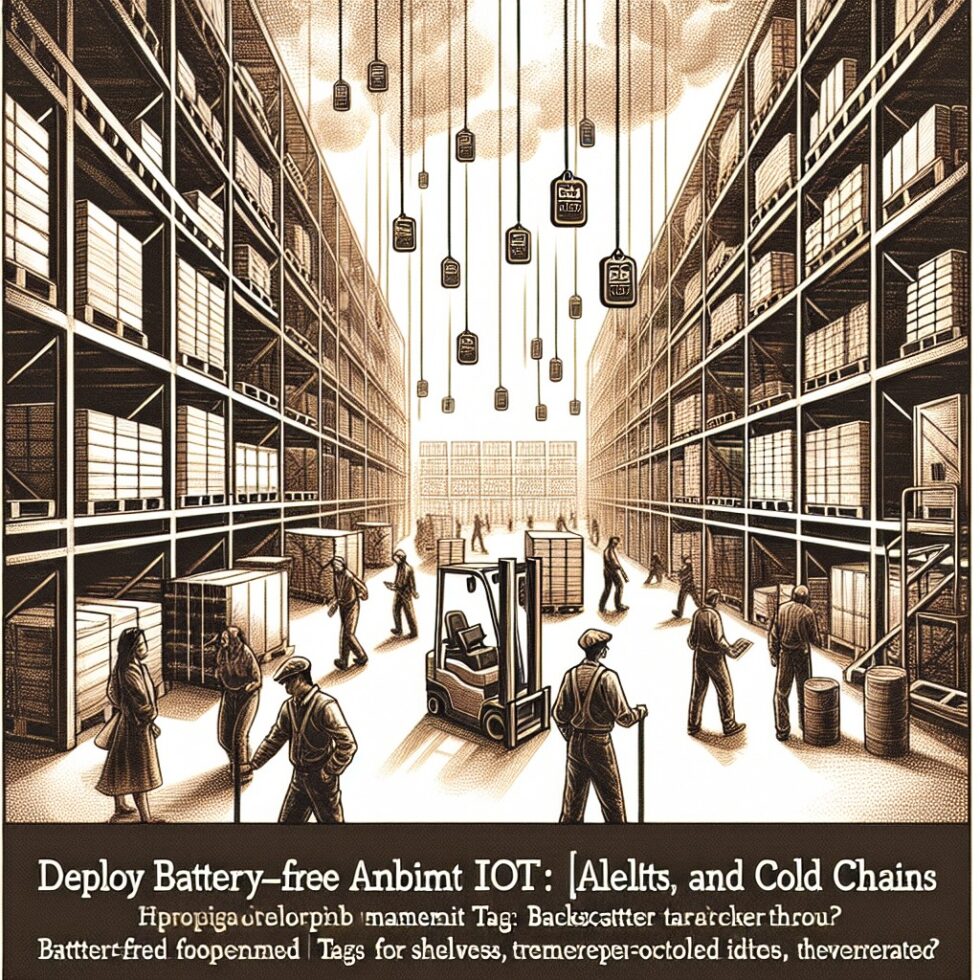
Why Ambient IoT Is Showing Up Everywhere
Stores, warehouses, and cold-chain operators want real-time visibility without maintenance headaches. Ambient IoT offers a new way to get it: stick-on tags that harvest energy and talk back using backscatter instead of powered radios. They can broadcast an identifier and bits of sensor data using energy pulled from nearby radio waves, indoor light, or small thermal differences. No batteries to swap. No last-mile wiring.
This guide explains what ambient IoT really is, where it’s useful right now, and how to deploy it without getting stuck in the weeds. You’ll learn how to size reader coverage, place tags on tricky materials, build a data feed that your inventory system can trust, and keep the whole setup secure and private.
What Ambient IoT Actually Is
Ambient IoT is a family of technologies for ultra‑low‑power sensing and identification. The tag doesn’t carry a powered transmitter. Instead, it uses a method called backscatter to reflect and subtly modulate existing radio waves in the environment. That modulation encodes the tag’s ID and, if supported, measurements like temperature or motion.
Backscatter, in plain words
Imagine a room with music playing. If you shake a mirror, you can reflect the music back with a ripple pattern. The ripple encodes information. Backscatter works the same way with radio. A tag changes the way it reflects radio energy from a reader or an ambient source. A nearby receiver picks up those tiny changes and decodes the data. This lets the tag function at microwatts of power.
Where tags get power
- RF harvesting: Tags harvest power from 2.4 GHz or sub‑GHz radio fields sent by readers, Wi‑Fi, or dedicated exciters.
- Indoor light: Small photovoltaic cells power simple sensors and a controller that drives the backscatter circuit.
- Thermal gradients: A thermoelectric element can produce a tiny current from temperature differences in cold chains or HVAC ducts.
These sources often combine, so a tag can collect just enough energy to wake up and broadcast on a schedule—every few seconds in good conditions, or every few minutes in sparse fields.
How it differs from “classic” RFID and BLE beacons
- UHF RFID (EPC Gen2): Gateways blast energy at 860–960 MHz and read tags over a few meters. It’s reliable for chokepoints like dock doors but not designed for continuous room‑wide telemetry.
- Battery BLE beacons: Beacons actively transmit, last months to years, and need battery changes. They’re great for people and assets, but maintenance adds up.
- Ambient IoT backscatter: Readers or ambient radios light up the space. Tags piggyback on that energy and modulate reflections. You get more frequent updates than RFID gates, with less maintenance than battery beacons.
Modern ambient IoT tags often encode data in Bluetooth‑compatible frames so they can be read by special receivers alongside conventional BLE traffic. Others target sub‑GHz for better penetration in dense packaging.
Where It Helps Today
Ambient IoT shines when you need constant, low‑touch visibility rather than sporadic scans. Here are practical scenarios that people actually ship:
Retail shelves and back rooms
- Stock gaps: Tag high‑shrink or high‑velocity SKUs. If a tag stops reporting at shelf level but shows up in the back room, the system flags a restock task.
- Planogram drift: Light sensors can tell whether tagged items sit on a top shelf (bright) or lower shelf (dim). You see when products wander.
- Self‑audits: Overnight, the store gets a near‑live map of where tagged items are, without pushing carts past gate readers.
Pallets, totes, and roll cages
- Chain‑of‑custody breadcrumbs: Readers at receiving bays, cool rooms, and staging areas create coarse location histories without barcode scans.
- Shock and tilt: Simple motion sensors detect drops or improper handling events en route.
- Reusable packaging: Stick one tag on a crate and see usage cycles and dwell times across sites.
Cold chains
- Temperature exposure: Battery‑free tags log excursions above thresholds. You get proof of compliance without refrigerated handhelds.
- Door discipline: Light spikes on pallet tags signal cooler doors left ajar. A local rule triggers alerts to staff.
Manufacturing and healthcare
- Kanban bins: Tags on bins broadcast presence. When a bin moves or empties, the change is detected by the nearest reader.
- Instrument trays: Metal complicates reads, but careful placement and spacers help track tray presence in prep rooms.
These use cases work because they don’t demand centimeter accuracy or rich data. They rely on presence, proximity, and lightweight telemetry.
Choosing Tags and Readers
Ambient IoT succeeds or fails on good hardware choices matched to your environment. Resist the temptation to buy the cheapest tag and hope. Start with clear requirements.
Tag types and what they cost
- ID‑only: Lowest cost, often paper‑thin. Expect prices to drop below a few dimes at volume. Good for shelf presence and simple inventory counts.
- ID + temperature: Slightly more costly. Look for tags that publish threshold breaches, not full logs—those are easier to power.
- ID + motion or light: Useful for handling events and basic location inference. Expect short bursts of updates when movement occurs.
- Form factors: Labels, stickers, hang tags, and on‑metal variants with a tiny spacer layer or tuned antenna.
Ask vendors for three things: typical update intervals at 1 m, 3 m, and 7 m; minimum reader density for your environment; and supported frame formats (e.g., BLE advertising compatible).
Readers, exciters, and antennas
- 2.4 GHz readers with exciters: These devices emit a controlled RF field and listen for backscatter frames. Range is typically 2–10 m per unit.
- Sub‑GHz readers: Better penetration through packaging and liquids, but check regional spectrum rules.
- Antennas and mounting: Patch antennas aimed down aisles increase uniformity. Ceiling mounts cover 30–60 m²; wall mounts can fill dead zones.
- Power and backhaul: Many readers support PoE. Backhaul can be Ethernet or Wi‑Fi. Make sure firmware updates are secure and easy.
How much coverage you need
Backscatter is sensitive to environment. Plan for 1 reader per 50–100 m² in retail spaces to get multi‑second updates. For pallet staging, one reader per 10–15 m of dock face usually catches all arrivals and departures. Cold rooms with metal and moisture need extra density. Pilot to confirm.
Update rate planning
With ambient power, you don’t force an update—you budget it. Set expectations around a median interval (say, 3–10 seconds) and accept that some tags will report slower at the edges. Build logic that can tolerate a tag missing several cycles before you call it “absent.”
The Deployment Playbook
You can get a small store or a single warehouse zone live in weeks if you follow a methodical process. Don’t try to tag everything at once. Tag what proves value in days.
1) Define events, not just data
Decide the decisions you want to trigger. Examples:
- “Notify back room when shelf tag disappears for 2 minutes.”
- “Flag a pallet as non‑compliant if temperature crosses 8 °C for more than 5 minutes.”
- “Open a restock task if five or more related item tags leave a bay within 10 minutes.”
These become your acceptance criteria for the pilot.
2) Bench test with real materials
Tag the actual items you care about—meat trays, glass bottles, detergent jugs. Measure update intervals at set distances while moving and stationary. Liquids absorb 2.4 GHz; metal detunes antennas. Try thin foam spacers or on‑metal tags to improve read rates.
3) Do a simple RF survey
Put a reader on a stand. Walk the area with 10 tagged items and a laptop showing live reads. Mark dead zones on a floor plan. You’ll often find trouble spots near refrigerators, endcaps, and elevator shafts.
4) Mount readers with service in mind
- Use PoE to simplify power and keep UPS coverage.
- Aim antennas to reduce reflections off metal. Slight tilts help.
- Label devices and ports. Document MAC, location, and IP in a shared sheet.
5) Attach tags the right way
- Orientation matters: Keep the long side of the antenna parallel to the reader’s polarization if the vendor specifies it.
- Spacing: On metal, add a 1–2 mm dielectric layer if the tag isn’t on‑metal rated.
- Adhesives: Use labels rated for cold and condensation in cold rooms.
6) Commission tags in a single sweep
Create a tag registry that maps the unique ID to item, SKU, pallet, or location. Do this with a mobile app that collects IDs as you stick them. Push the mapping to the server right away to avoid orphaned tags in your data.
7) Build a resilient data pipe
- Transport: MQTT is a good default. Keep payloads small and versioned. Publish per reader and per logical area.
- Topics: Use a structured pattern like site/zone/reader/tagID.
- Edge filtering: Readers or a nearby gateway should de‑duplicate bursts so the cloud only sees meaningful state changes.
- Storage: Time‑series DB for raw reads; relational table for tag registry and events. Retain raw reads for investigations.
Sensors That Matter (and Those That Don’t)
Battery‑free tags have a tiny energy budget. Pick sensors that give the most value per microwatt.
Temperature
Top pick for cold chain and refrigerated shelves. Favor tags that encode threshold crossings (above/below band) instead of high‑resolution logs. Validate with a calibrated probe during pilot.
Light
Useful for proxying shelf position or detecting door open events. Set per‑site thresholds because store lighting varies. Dimming during off hours can be a feature, not a bug—changes stand out.
Motion/acceleration
Great for shock detection and handling events. Tune the sensitivity to avoid false positives when forklifts drive by. Treat motion as a hint that increases confidence in location changes.
What to skip for now
High‑rate sensors (e.g., continuous humidity, audio, or vibration) usually don’t fit a battery‑free power budget. If you need them, consider a hybrid design with a tiny rechargeable cell powered by light.
Security and Privacy Without Batteries
Security is harder when the tag can’t power heavy crypto. But you can still design a system that is hard to spoof and safe to operate.
Threats to address
- Tracking: A static ID could be read by anyone nearby. Use vendors that support rotating identifiers or obfuscated frames.
- Spoofing: An attacker could replay a known frame. Filter reads by spatio‑temporal consistency—if a tag suddenly appears in two far‑apart zones, drop the improbable one.
- Gateway compromise: Readers are IP devices. Secure boot, signed firmware, and network segmentation are non‑negotiable.
Practical safeguards
- Reader auth: Use mutual TLS to your broker. Pin certificates at the gateway.
- Private VLANs: Keep readers off the general store or plant network.
- Data minimization: Only store the mapping of tag IDs to SKUs internally. Externally, keep IDs pseudonymous.
- Rotate secrets: If your vendor supports key rolling for frame obfuscation, schedule it. If not, rotate tags out on a predictable lifecycle.
Operating Costs and ROI
Ambient IoT gets attention because the math can work quickly—especially where labor is tight or compliance matters.
Typical cost drivers
- Tags: ID‑only tags can be well under a dollar at scale; sensors cost more. Plan loss and replacement rates in retail.
- Readers and exciters: $150–$800 per unit depending on radios and antennas. Density drives cost more than unit price.
- Install: PoE cabling and mounts. Try to piggyback existing network drops when feasible.
- Software and backhaul: Broker, database, dashboards, and integration time. Cloud costs are modest for these small payloads.
Where the payoff comes from
- Fewer out‑of‑stocks: A 10–20% reduction in missed sales for top SKUs can pay for readers fast.
- Shrink control: Knowing that high‑shrink items leave a zone triggers staff action with minimal friction.
- Compliance: Cold‑chain proof avoids rejected loads and fines.
- Labor savings: Fewer manual scans and audits. Teams work on exceptions instead of hunting.
Model ROI with a pilot using real interventions. Don’t just count reads; count resolved events.
Troubleshooting and Metrics That Matter
You’ll know the system works when your live dashboard stays calm and your exception queue gets small. Until then, watch the right metrics and fix the right things.
What to measure
- Update interval distribution: Median and 95th percentile per zone. Aim for stable medians and tame tails.
- Read probability: Fraction of expected updates you receive per minute per tag cohort.
- False absences: Tags marked absent that reappear within a short window. Reduce with better coverage or longer grace periods.
- Heat maps: Visualize read density to spot dead zones around metal fixtures.
Common issues and fixes
- Liquids absorb 2.4 GHz: For beverages and meats, use sub‑GHz tags or add more readers and spacers.
- Metal detunes antennas: Use on‑metal tags or place on plastic signage instead of direct metal contact.
- Reader self‑interference: Stagger reader channels or duty cycles. Coordinate exciter timing if your vendor supports it.
- Backhaul congestion: Batch local updates and publish deduplicated events rather than every raw read.
- Tag loss: In retail, adhesives fail. Use tamper‑evident labels and test adhesives in refrigerated and humid areas.
Interoperability and Standards Watch
Ambient IoT is maturing fast. Keep an eye on interoperability so you don’t get stuck with islands.
Protocols and alliances
- Bluetooth‑compatible frames: Some ambient tags encode data as BLE‑like advertising so they can be decoded by multi‑radio gateways.
- UHF RFID upgrades: Newer reader features blur lines between periodic scans and ambient presence detection. Mixed fleets are possible.
- Industry groups: Carriers and vendors promote Ambient IoT under GSMA. Expect profiles for inventory, cold chain, and returnable transport items.
Sustainability and recyclability
Battery‑free tags can be more recyclable. Ask vendors about adhesives, inks, and chip packaging. Favor designs that survive normal recycling streams or are easy to remove before reprocessing.
A Pilot You Can Run in 30 Days
Here’s a concrete pilot plan that gets real answers without a blank‑check project.
- Week 1: Define event criteria. Order 200 ID‑only tags, 50 temp+light tags, and 6 readers. Prepare a small MQTT broker and dashboard.
- Week 2: Bench test with your products. Place tags, measure updates. Decide on spacers and adhesive. Draft the tag registry format.
- Week 3: Install readers in one aisle or a dock area. Commission tags and start the event dashboard. Train staff on two workflows, e.g., restock and temp response.
- Week 4: Tune thresholds, adjust reader angles, and audit false absences. Write up ROI from actual events handled.
If the pilot shows reliable events with light touch from staff, expand to the next zone and add integration to inventory or WMS.
Design Patterns That Keep You Sane
- Edge intelligence, cloud simplicity: De‑dupe and compress near the readers. Keep the cloud focused on state and events, not raw physics.
- Graceful absence logic: Model presence with hysteresis. A tag needs to be missing several times in a row before it’s “gone.”
- Device twins for tags: Maintain a per‑tag record with last seen, last sensor values, and current state. This makes UI and analytics straightforward.
- Event‑driven ops: Push tasks to staff devices with clear resolution actions. Every alert should be actionable, not informational noise.
What’s Next
Expect readers to get smarter and cheaper, and tags to add a few more bits of useful telemetry without sacrificing battery‑free life. Printed electronics will pressure costs. Standards will settle on a handful of profiles that buyers can trust across vendors. And as ambient fields show up in more public places—stores, stations, clinics—privacy‑preserving designs will be the norm, not an add‑on.
Most importantly, teams will stop thinking in terms of “reads” and focus on business events. That’s the shift that makes ambient IoT feel like magic in daily operations rather than another dashboard to babysit.
Summary:
- Ambient IoT uses backscatter and energy harvesting to deliver ID and sensor data without batteries.
- It’s best for continuous presence and lightweight telemetry in retail, logistics, cold chain, and light manufacturing.
- Choose tags (ID‑only or with temperature, light, motion) and readers (2.4 GHz or sub‑GHz) based on your environment.
- Plan coverage at roughly one reader per 50–100 m²; pilot to confirm in metal‑ and liquid‑heavy areas.
- Design your system around events, not raw reads. Use MQTT, edge de‑duplication, and device twins.
- Security relies on rotating or obfuscated IDs, gateway hardening, private networks, and data minimization.
- ROI comes from fewer out‑of‑stocks, reduced shrink, compliance proof, and labor savings.
- Watch standards and recyclability; pick vendors with clear roadmaps and interoperability plans.