
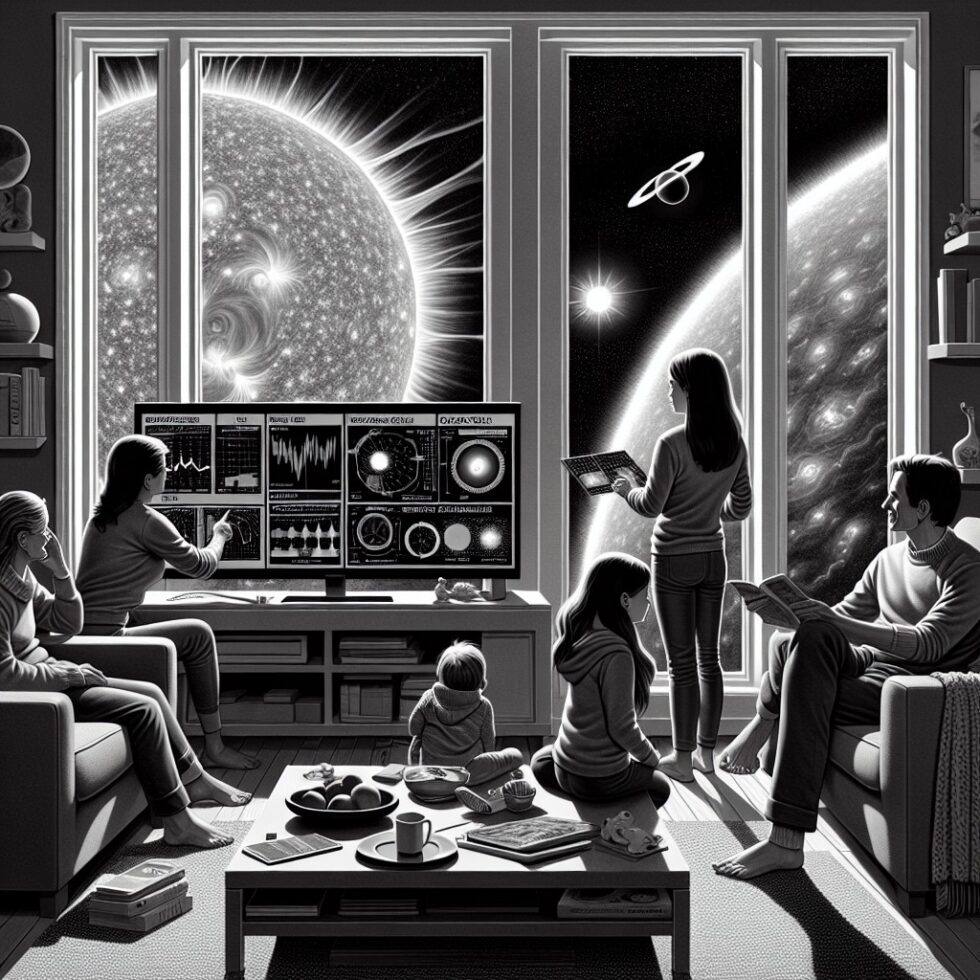
Space weather sounds far away until it knocks out radio links, disturbs GPS, or drives a surprise aurora over your backyard. You do not need a million‑dollar observatory to experience it. With a few careful choices, you can build a small, dependable station that feels solar activity as it happens: radio blackouts from a flare, magnetic wiggles from a geomagnetic storm, and slow changes in the ionosphere that bend and scatter radio waves.
This article shows you how to monitor the sky’s electric heartbeat from home using low‑cost sensors, some smart placement, and clean data practices. We focus on what you can actually sense at ground level, how to design a quiet setup, and how to turn raw traces into clear alerts you’ll trust.
What Counts as Space Weather You Can See at Home
Space weather includes solar events and the chain of effects they trigger in Earth’s magnetic field and atmosphere. From a home station, you can track a few practical signals:
- Radio blackouts (R-scale): Solar flares blast X-rays that thicken the ionosphere’s D-layer. HF (3–30 MHz) radio goes quiet on the sunlit side. You can “see” this with VLF beacons around 15–30 kHz as an amplitude dip or surge.
- Geomagnetic storms (G-scale): Coronal mass ejections rattle Earth’s magnetic field. The intensity (Kp index) often correlates with aurora visibility. A sensitive magnetometer can watch the field unspool and snap back.
- Ionospheric irregularities: These shift GPS/GNSS signals and add timing noise. You can infer this via Total Electron Content (TEC) and scintillation metrics, either from your own GNSS receiver or public data feeds.
Think of your station as a small orchestra: a VLF “ear” listening to beacons for flare signatures, a magnetometer “compass” that twitches during storms, and a GNSS “thermometer” that reads the ionosphere’s state along sky‑crossing paths.
Signals You Can Sense Reliably
1) VLF Beacons: Flares in Real Time
Very low frequency (VLF) transmitters—long‑range navigation and time beacons—bathe continents in strong, stable signals. A sudden ionospheric disturbance (SID) from a flare will alter the path and absorption, which shows up as a fast change in received amplitude. You can target a few known stations (like the 24.0 kHz NAA transmitter in Maine) and watch for sudden steps or spikes in your trace during daylight.
2) Geomagnetism at the Surface
During geomagnetic storms, regional magnetic field components can swing by tens to hundreds of nanotesla (nT). With a well‑placed sensor, you can record gentle diurnal curves on quiet days and dramatic wiggles on stormy nights. The trick is a magnetometer with enough resolution and a site far from cars, pipes, steel fences, and home wiring.
3) GNSS‑Based Ionospheric Clues
GNSS signals cross the ionosphere, picking up delays proportional to electron content. By comparing different frequencies from the same satellite, you can estimate TEC and spot periods of rapid change or scintillation that degrade navigation. Even if you skip your own receiver, public TEC maps and indices can extend your station’s “eyes.”
Build a Simple VLF SID Monitor
Goal: Detect solar flares during the day by measuring changes in a strong VLF beacon’s signal level. You’ll build a small loop antenna, amplify it, and digitize the amplitude for logging.
Antenna
- Loop type: A square air‑core loop (e.g., 0.5–1 m per side with 10–30 turns) or a ferrite rod wound with enamel wire.
- Tuning: A resonant LC can boost sensitivity, but a broadband loop plus band‑pass filter near your target beacon also works. Avoid sharp resonance if you want to monitor multiple stations.
- Placement: Indoors works if far from appliances; outdoors in a weatherproof box is ideal. Rotate for the strongest, quietest signal.
Front End and Digitization
- Preamp: A low‑noise amplifier with a band‑pass filter centered near your beacon (e.g., 24 kHz ± 1–3 kHz) keeps mains hum and switching noise out.
- ADC: You can rectify and low‑pass the envelope and feed it to a microcontroller ADC (≥12‑bit), or sample digitally and demodulate in software. Even a USB audio interface can work if the chain is downconverted.
- Timebase: Sync your logger with NTP. Flares happen fast; a second or two of timing drift can blur their signature.
What a Flare Looks Like
A moderate flare often shows as a fast rise or dip (seconds to minutes), sometimes followed by a slow recovery. Compare multiple stations if possible—if they move together, it’s likely a real SID. Cross‑check with public R‑scale alerts for confidence.
Make a Low‑Cost Magnetometer That Works
Goal: Track magnetic field changes from geomagnetic storms. You don’t need observatory‑grade gear, but you do need stability and a clean environment.
Sensor Choices
- PNI RM3100: A good balance of resolution and cost. It resolves small changes (nT‑level) with proper averaging. Interface via SPI to a microcontroller or single‑board computer.
- MLX90393 / HMC5883L clones: Cheaper, but often too noisy for subtle events. They might still show big storms if well shielded and averaged.
- Smartphones: Built‑in magnetometers have limited resolution and drift. OK for demos, not for continuous logging.
Mounting and Site Survey
- Distance from metal: Mount at least a few meters from fences, vehicles, iron pipes, or mains wiring. Underground cables count too.
- Thermal stability: Temperature swings shift readings. Shade and ventilate your enclosure, and log temperature to compensate if your sensor supports it.
- Orientation: Fix the sensor orientation and keep it unchanged so you can compare days reliably. Absolute calibration is nice; relative change is your main signal.
Sampling and Filtering
- Rate: 1–10 Hz is fine. Storms are slow compared to audio, but brisk compared to weather. Higher rates make it easier to filter out 50/60 Hz hum.
- Filtering: Apply a notch (50/60 Hz) and a moving average (e.g., 10–60 s). Record raw plus filtered streams if you can.
- Baseline: Keep a daily median for each axis. Alert on sustained departures (e.g., >50–100 nT from the quiet median) to catch storm onsets.
See the Ionosphere With GNSS
Goal: Watch the ionosphere’s “thickness” via dual‑frequency GNSS. As electron content rises or fluctuates, positioning degrades, and HF/VHF propagation changes.
Hardware and Software
- Receiver: A dual‑frequency module such as the u‑blox ZED‑F9P gives raw observations (L1/L2). Mount an appropriate antenna with an unobstructed sky view.
- Processing: Use software like RTKLIB to extract per‑satellite delays and estimate slant TEC. Plot TEC time series by satellite “prn” and elevation.
- Shortcuts: If hardware is out of scope, use public TEC maps and scintillation indices to fill this role. It still completes your station’s picture.
What to Look For
On calm days, TEC tracks the solar zenith smoothly. During disturbed periods, you’ll see rapid changes and increased scatter. Scintillation can spike in the evening at low latitudes and at high latitudes during auroral activity.
Data Pipeline: Clean, Time‑Aligned, and Usable
Space weather is not a single number; it’s multiple signals moving together. To make your station useful, get the plumbing right.
Logging
- Timestamps: Sync everything with NTP and record in UTC. Space weather products and alerts use UTC.
- Format: A line protocol for a timeseries database (InfluxDB) or JSONL files works well. Keep daily rotation to avoid huge files.
- Metadata: Record location, sensor orientation, antenna notes, and filter settings once and keep them with the dataset.
Visualization and Cross‑Checks
- Dashboards: Grafana or a simple web chart lets you see all streams together—VLF amplitude, magnetometer axes, TEC.
- Overlays: Show public Kp, R‑scale, or solar wind data on the same timeline to confirm your events.
- Events: Annotate flares and storm onsets with shaded regions so you can compare different days quickly.
Alerts
- Rules: Example: If VLF amplitude shifts by >3 dB in under 2 minutes during local daylight, send a “possible flare” alert.
- Storms: If your magnetometer deviates >75 nT from the daily median for >10 minutes, flag a “local geomagnetic disturbance.”
- Context: Include current NOAA alerts and Kp forecasts in your notification so you know whether it’s likely global or just local noise.
When to Watch: Reading R, G, and Kp
NOAA’s scales make it simple to know what to expect:
- R-scale (Radio Blackouts): R1–R5. Even R2 events often show cleanly on VLF monitors.
- G-scale (Geomagnetic Storms): G1–G5. G2 and above, with Kp ≥6, often push auroras into mid‑latitudes and wiggle your magnetometer.
- Kp index: 0–9 quasi‑logarithmic. Good for aurora watchers; combine it with real‑time solar wind speed and Bz polarity for better nowcasting.
Watch the solar wind: a strong southward Bz with elevated speed is a classic storm setup. When alerts mention a halo CME with short transit time, get your station ready.
A Weekend Build Plan
Bill of Materials (example)
- VLF antenna: 100 m of 24–28 AWG enamel wire, PVC frame or ferrite rod, weatherproof box.
- Front end: Low‑noise op‑amp, band‑pass filter components, shielded cable.
- Magnetometer: PNI RM3100 breakout, small microcontroller or Raspberry Pi.
- GNSS (optional): ZED‑F9P breakout, dual‑frequency antenna with ground plane and low‑loss coax.
- Power and housing: 5 V supply, waterproof enclosures, strain reliefs, silica gel packs.
Steps
- Saturday AM: Wind the loop, assemble the amplifier, and bench test with a function generator or known beacon. Verify SNR vs. room noise.
- Saturday PM: Mount the loop outdoors or in the attic, route shielded cable, and start logging amplitude. Note beacon IDs and frequencies.
- Sunday AM: Install the magnetometer away from metal, fix its orientation, and start 1–10 Hz logging with timestamps.
- Sunday PM: If using GNSS, mount the antenna with a clear sky view, enable raw logging, and run a short TEC extraction test.
- Evening: Build a simple dashboard. Overlay public Kp and flare lists. Trigger a test alert using a simulated event.
Troubleshooting and Noise Hunting
VLF Gremlins
- Hum and switching hash: Try a different antenna orientation, tighten the band‑pass, or move farther from power lines and solar inverters.
- Drift: If the amplitude drifts with temperature, stabilize the preamp environment and ensure the loop isn’t flexing in the wind.
- No events show: Confirm you’re locked on a strong station and check daylight flares against public alerts to set expectations.
Magnetometer Artifacts
- Step jumps: Passing cars, elevators, or doors with steel hardware cause abrupt spikes. Relocate farther from buildings and roads.
- Diurnal wiggles only: That’s a good sign—your baseline is clean. Real storms will still stand out as larger excursions.
- Axis cross‑talk: Keep orientation fixed. If you must move the sensor, re‑establish your baseline.
GNSS Quirks
- Multipath: Nearby rooftops or trees reflect signals. Elevate the antenna on a ground plane and keep clear sky in all directions.
- Data gaps: Maintain stable power and clean USB or UART links. Use a watchdog to restart logging if the stream stalls.
- TEC outliers: Filter by elevation angle (e.g., >20°) and remove sudden steps caused by satellite switches.
Stay Safe and RF‑Smart
Monitoring is passive, but your build still touches the real world. Keep the station safe and your spectrum neighbors happy.
- No transmitting: You do not need to emit any RF. Your setup is receive‑only.
- Lightning and weather: Use surge protection. Do not mount antennas on tall conductive masts unless they are properly grounded and bonded.
- Isolation: Keep long cables away from mains wiring. Use ferrites and shielded cable to avoid coupling hum.
- Respect property: Get permission before mounting antennas on shared structures.
Make It Social and Useful
Your data becomes more valuable when compared and shared. You can join citizen networks and projects that welcome fresh, well‑documented streams.
- SID monitors: Programs inspired by educational networks (like the Stanford Solar Center’s SID/SuperSID) collect VLF flare detections across continents.
- Magnetometer networks: Compare your plots with regional observatories to validate events. If you maintain stable uptime, reach out to communities that aggregate amateur stations.
- GNSS science: Even if you don’t compute TEC yourself, you can overlay public indices to make your local record more informative and to learn how your region responds to global events.
Turn Traces Into Insights
Raw lines mean little without interpretation. A few strategies help you turn measurements into decisions:
- Event diaries: Keep a simple log with UTC timestamps, weather notes, power changes, and unusual nearby activity (construction, new appliances).
- Comparative days: Save a “quiet day” profile for each sensor. Plot current data against it to highlight deviations.
- Lag awareness: A CME takes time to travel. Expect VLF flare signatures first, then (often a day later) magnetometer action, then extended ionospheric variability.
Why This Matters Beyond Hobby Value
Space weather touches everyday systems: HF communications, airline polar routes, pipeline monitoring currents, satellite drag, and your phone’s navigation. A small, honest station helps you learn how these systems misbehave and, in a small way, improves community awareness. During busy solar periods, home monitors have flagged flares and local storm strength in near real‑time, giving skywatchers and radio operators a head start.
Going Further
- Better antennas: Add an orthogonal loop to compare polarizations or watch multiple beacons with a switch matrix.
- Absolute geomagnetism: Explore fluxgate sensors with temperature‑controlled enclosures for improved stability.
- Automated nowcasts: Fuse your data with real‑time solar wind and Kp predictions to estimate local aurora chances with a simple probability model.
- Quiet power: Try a battery buffer with a linear regulator for the RF front‑end to cut switching noise.
Summary:
- Space weather can be sensed at home via three practical channels: VLF beacons (flares), magnetometers (geomagnetic storms), and GNSS data (ionospheric state).
- A simple loop antenna, clean preamp, and steady logging reveal sudden ionospheric disturbances during daylight flares.
- A low‑cost magnetometer like the RM3100, mounted away from metal with stable sampling, captures storm‑time magnetic swings.
- Dual‑frequency GNSS receivers estimate TEC; public TEC and scintillation data complement or replace local measurements.
- Sync timestamps, log cleanly, visualize streams together, and cross‑check with public R/G/Kp alerts for confidence.
- Focus on site selection, filtering, and safety. Start with reliable baselines before chasing rare events.
- Share and compare data with citizen networks to turn hobby traces into useful community signals.
External References:
- NOAA Space Weather Prediction Center
- NOAA Real‑Time Solar Wind
- SuperMAG: Ground magnetometer data and plots
- University of Alaska Fairbanks Aurora Forecast
- Stanford Solar Center: SID and SuperSID resources
- u‑blox ZED‑F9P Dual‑frequency GNSS module
- RTKLIB: Open source GNSS processing
- British Geological Survey: Geomagnetism
- Society of Amateur Radio Astronomers