

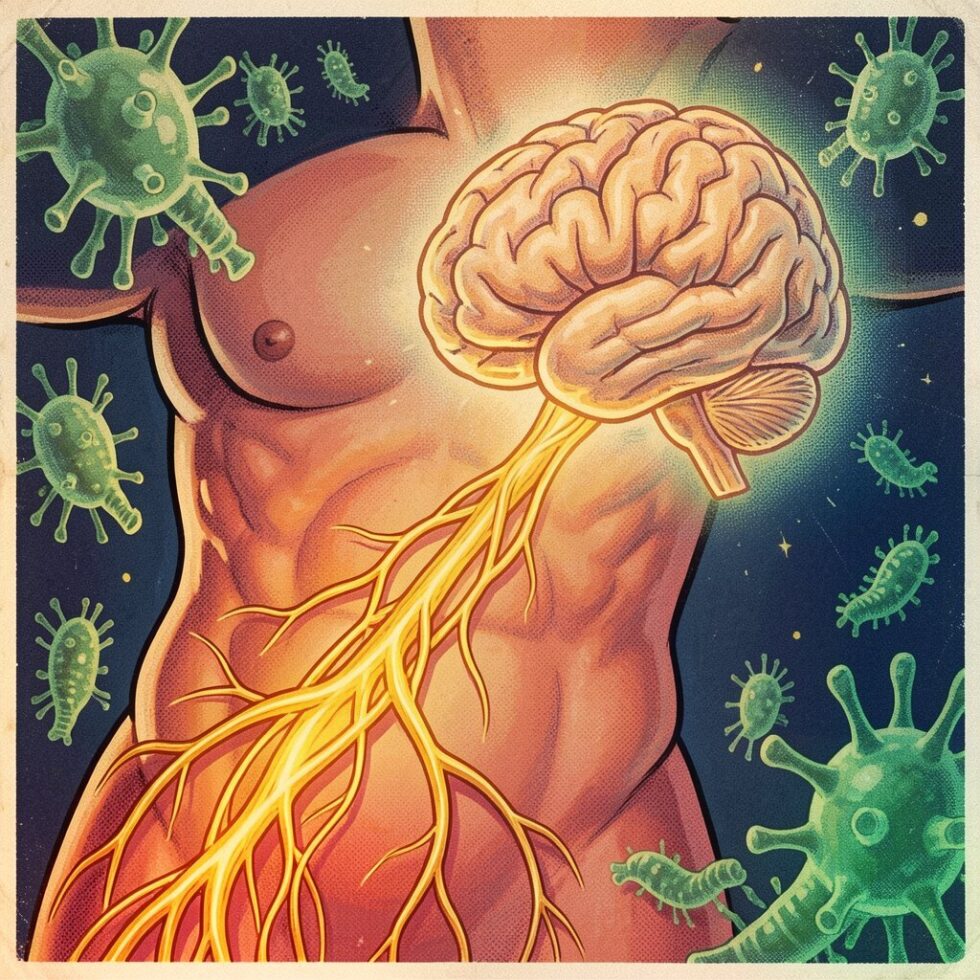
Suddenly, everyone is talking about the gut. Not just as a digestion machine, but as an organ that whispers directly into the brain. A wave of studies published between 2024 and 2026 has moved the gut-brain axis from a promising hypothesis to one of the most active frontiers in neuroscience. The central player in this story is the vagus nerve, a thick cable of fibers that runs from the brainstem down through the neck and into the abdomen, listening to what the intestines have to say.
For most of the twentieth century, memory loss was treated as a problem that started and ended in the brain. That view is now under revision. In March 2026, a team at Stanford Medicine and the Arc Institute showed that age-related memory decline in mice is driven, in large part, by changes in the gut and that restoring gut-brain communication brought the animals’ memories back to youthful levels. The finding does not mean a bowl of yogurt will sharpen your recall tomorrow. It does mean the brain listens far more closely to the gut than scientists assumed even five years ago.
What Is the Gut-Brain Axis?
The gut-brain axis is the two-way communication network that links your digestive tract with your central nervous system. It has three main channels. First, there is the nervous channel: the vagus nerve, which carries sensory signals from the gut up to the brain, and the enteric nervous system, a mesh of more than 100 million nerve cells embedded in the walls of the gut that Johns Hopkins Medicine researchers describe as a kind of second brain. Second, there is the chemical channel: gut microbes produce and transform molecules, including short-chain fatty acids and precursors of neurotransmitters, that enter circulation and interact with the immune system. Third, there is the hormonal channel: gut cells release hormones that influence satiety, stress responses, and even the activity of brain regions involved in emotion.
What makes the new research compelling is not any single pathway but the way they converge. A study from UCLA published in Nature Mental Health in 2024 surveyed 116 people about their resilience to stress, then scanned their brains and sequenced their stool samples. People in the high-resilience group showed neural activity associated with better emotional regulation, and their gut microbes carried gene activity linked to low inflammation and a strong gut barrier. Resilience, the authors concluded, is a whole-body phenomenon.
The Vagus Nerve: A Direct Line, Not a Metaphor
The vagus nerve is the longest cranial nerve in the body, and roughly 80 percent of its fibers carry information from the body to the brain rather than the other way around. It is the physical line through which gut signals reach structures like the hippocampus, the brain region where memories are encoded. Surgeons have exploited this line for decades: implanted vagus nerve stimulators are approved by the United States Food and Drug Administration for epilepsy, depression, and stroke recovery.
The Stanford team, led by Christoph Thaiss and Maayan Levy, took this logic in reverse. If the vagus is the channel through which gut inflammation dampens memory, then boosting its activity should restore memory. In aging mice whose vagus signaling had been suppressed by gut inflammation, a molecule that activates the nerve did exactly that. Old animals performed in memory tests as well as young ones. Thaiss described the result as a kind of remote control for the brain, reached from the gastrointestinal tract.
What the New Studies Actually Show
Memory and aging
The March 2026 Nature paper charted a high-resolution map of how the mouse microbiome changes with age. Old mice carried more of a bacterium called Parabacteroides goldsteinii, along with higher levels of medium-chain fatty acids. Those metabolites provoked immune cells in the gut to mount an inflammatory response, and that response suppressed vagus nerve signaling to the hippocampus. The chain of cause and effect was unusually complete: changing one link, the microbe or the nerve, changed the outcome. When young mice were housed with old ones, their microbiomes shifted toward the older profile and their memory scores dropped. Two weeks of broad-spectrum antibiotics restored their performance.
None of this proves that the same sequence operates in humans. The authors are explicit about that. But a separate study published in Molecular Psychiatry in September 2026 found the first direct human evidence that the gut’s metabolic capacity is associated with brain chemistry. Researchers at the University of Surrey and the University of Roehampton measured GABA and glutamate, two of the brain’s key chemical messengers, in three brain regions of 61 young women using proton magnetic resonance spectroscopy, while sequencing the participants’ gut bacteria. Different microbial pathways tracked with different brain regions, suggesting the gut-brain axis is regionally specific rather than a single dial.
Mood and stress
Human intervention trials are now arriving. A randomized, placebo-controlled trial published in npj Mental Health Research in April 2025 gave 88 healthy volunteers a multispecies probiotic or a placebo for four weeks. Standard questionnaires barely moved, but daily mood reports showed a clear reduction in negative mood starting around two weeks in. A separate randomized trial in Communications Medicine in July 2026 found that some brain effects of six weeks of probiotic supplementation in older adults persisted four to six weeks after people stopped taking it.
Results are not uniform, and that is worth saying plainly. A study of students facing exams found that a specific Lacticaseibacillus rhamnosus strain increased Faecalibacterium, a bacterium associated with lower anxiety. A Polish cohort study of 280 medical students found a V-shaped relationship between fermented food intake and sleep quality under stress, with moderate consumption associated with the best sleep. The lesson from the current literature is that strain, dose, and context matter, and that averages hide individual variation.
Neurodegeneration
The strongest disease signals involve Parkinson’s disease. Gastrointestinal symptoms such as constipation often precede motor symptoms by years, and alpha-synuclein, the protein that clumps in Parkinson’s brains, has been detected in the gut up to two decades before diagnosis. A 2025 review in the Journal of Neurology lays out the gut-first model: microbial imbalance and inflammation increase gut permeability, misfolded proteins seed in the intestinal nervous system, and travel upward along the vagus nerve. Evidence remains contested, including mixed results from vagotomy studies, but the model has reshaped how researchers search for early biomarkers.
Alzheimer’s disease research follows a similar pattern. A 2026 scoping review in Frontiers in Aging Neuroscience identifies three pathways linking gut dysbiosis to cognitive decline: reduced production of protective short-chain fatty acids, systemic inflammation from a leaky gut barrier, and neurotoxic metabolites such as secondary bile acids. None of these is a confirmed cause of dementia in humans. All of them are now active targets for intervention studies.
The Serotonin Myth You Should Stop Repeating
Popular articles love the claim that “90 percent of your serotonin is made in your gut, so your gut controls your happiness.” The statistic is roughly right and the conclusion is wrong. Most of the body’s serotonin is indeed synthesized by enterochromaffin cells in the intestines, but peripheral serotonin does not cross the blood-brain barrier in meaningful amounts. Brain serotonin is made inside the brain from dietary tryptophan. As a 2020 review in the Turkish Journal of Gastroenterology notes, patients with carcinoid tumors, which flood the body with intestinal serotonin, are not euphoric; they are frequently anxious and depressed. Gut chemistry influences the brain through several routes, but a gut-made serotonin molecule is not the one acting on your mood circuits.
What You Can Actually Do
The strongest human evidence today belongs to diet, not supplements. The largest dataset comes from the PREDIMED family of trials in Spain. In a randomized trial published in the Journal of Neurology, Neurosurgery and Psychiatry, older adults at cardiovascular risk who followed a Mediterranean diet improved cognition compared with controls. A 2025 analysis in BMC Medicine followed 746 older adults for six years and found that both adherence to the Mediterranean diet and a gut microbial signature associated with that diet predicted slower cognitive decline. The favorable signature was rich in butyrate-producing bacteria such as Barnesiella and Butyricicoccus.
Those findings converge with a review from John Cryan’s laboratory, one of the founding groups of the field, on fiber and fermented foods. Fiber feeds bacteria that produce short-chain fatty acids. Fermented foods add live microbes and fermentation products. A reasonable, evidence-aligned pattern looks like this:
- Build meals around vegetables, legumes, whole grains, nuts, and olive oil, the core of the Mediterranean pattern that has randomized-trial support for cognition.
- Aim for variety in plant foods, since microbial diversity tracks with the range of fibers you eat.
- Treat fermented foods such as yogurt, kefir, sauerkraut, and kimchi as a regular component rather than a cure, keeping in mind that the measured benefits are modest and sometimes nonlinear.
- Be skeptical of specific probiotic claims for memory or mood. Strain-specific effects are real but narrow, and most tested benefits are small and slow.
- Remember that probiotics are not antidepressants. Clinicians who study them say so explicitly.
Direct manipulation of the microbiome is also moving, carefully, into medicine. The FDA regulates fecal microbiota products as biologics, and approved products exist for a specific infection, recurrent Clostridioides difficile. Everything else, from over-the-counter transplants to unregulated “microbiome resets,” is unproven and carries real risk. Anyone selling a gut intervention for dementia prevention is running ahead of the evidence.
Where the Field Goes Next
Three questions will define the next five years. The first is whether vagus-directed interventions work in people, not just mice. The Stanford group is investigating non-invasive ways to monitor and modulate peripheral nerve activity, and existing approved stimulators give the approach a regulatory head start. The second is whether microbiome signatures can serve as early warning markers for cognitive decline, which requires large longitudinal cohorts like the Spanish one already underway. The third is whether the benefits seen in young, healthy volunteers extend to the people who need them most. The honest answer today is that some effects appear in healthy adults, stronger effects appear in clinical populations, and nobody yet knows who benefits most.
The deeper shift is conceptual. Memory and mood are no longer brain-intrinsic properties. They are the output of a conversation between the brain and the body, and the gut holds one end of the line. The science is early, the hype is real, and the practical advice that survives contact with the evidence is unglamorous: eat more plants and fermented foods, sleep, move, and stay skeptical of anyone selling a shortcut. The vagus nerve has been listening all along.
Frequently Asked Questions
What is the gut-brain axis?
It is the two-way communication network that links your digestive tract with your central nervous system. It operates through three main channels: the nervous channel (the vagus nerve and the enteric nervous system), the chemical channel (molecules produced and transformed by gut microbes), and the hormonal channel (gut hormones that influence satiety, stress responses, and emotion-related brain regions).
Did researchers really restore memory by acting on the gut?
Yes, but so far only in mice. In the March 2026 Stanford study, aging mice whose vagus signaling had been suppressed by gut inflammation performed in memory tests as well as young animals once the vagus nerve was activated. The authors are explicit that this exact sequence has not been proven to operate in humans.
If 90% of serotonin is made in the gut, doesn’t that mean the gut controls happiness?
No, that popular conclusion is wrong. Most of the body’s serotonin is indeed synthesized by intestinal cells, but peripheral serotonin does not cross the blood-brain barrier in meaningful amounts; brain serotonin is made inside the brain from dietary tryptophan. The article notes that patients with carcinoid tumors, which flood the body with intestinal serotonin, are frequently anxious and depressed rather than euphoric.
What can I actually do to support memory and mood through my gut?
The strongest human evidence belongs to diet, not supplements. The article recommends a Mediterranean-style pattern built around vegetables, legumes, whole grains, nuts, and olive oil, variety in plant foods, and fermented foods like yogurt, kefir, sauerkraut, and kimchi as a regular component. A 2025 BMC Medicine analysis found that both Mediterranean diet adherence and an associated gut microbial signature predicted slower cognitive decline.
Should I take probiotics for memory or mood?
They can, but the effects are small and uneven. In daily mood reports, some randomized trials recorded a drop in negative mood after about two weeks, and a few brain-level changes lingered for weeks after supplementation stopped. Other trials found nothing. The researchers behind these studies are careful to point out that probiotics are not a replacement for antidepressants.
Summary:
- The gut-brain axis is a real, measurable communication network running through the vagus nerve, immune signaling, and gut-derived molecules.
- A 2026 Stanford study showed that restoring vagus signaling erased age-related memory deficits in mice, identifying a gut bacterium and its metabolites as upstream drivers.
- Human studies now link gut microbial activity to brain chemistry, mood, and cognitive trajectories, though effects are strain-specific and modest.
- The “90 percent of serotonin is made in your gut” claim is true as a statistic and wrong as a conclusion, because gut serotonin does not cross into the brain.
- The best-supported practical steps are dietary: a Mediterranean-style pattern, diverse plants, and fermented foods, with realistic expectations about probiotics.
- People with digestive disorders should discuss persistent symptoms with a clinician rather than self-treating with supplements.
Related Reading
- earbuds as health and ID sensors — related guide.
External References:
- Intestinal interoceptive dysfunction drives age-associated cognitive decline (Nature, 2026)
- Enhancing gut-brain communication reversed cognitive decline in aging mice (Stanford Medicine, 2026)
- Empirical evidence for gut microbial influence on human brain chemistry (Molecular Psychiatry, 2026)
- Probiotics reduce negative mood over time (npj Mental Health Research, 2025)
- Probiotic effects on brain health persist after discontinuation (Communications Medicine, 2026)
- Probiotic effects on the gut microbiome in students under academic stress (npj Biofilms and Microbiomes, 2025)
- Fermented food consumption and sleep quality under stress (Food Science and Nutrition, 2025)
- Stress-resilience and brain-gut microbiome interactions (Nature Mental Health, 2024)
- The gut-brain axis in early Parkinson’s disease (Journal of Neurology, 2025)
- Mediterranean diet, gut microbiota, and cognitive decline (BMC Medicine, 2025)
- Mediterranean diet improves cognition: PREDIMED-NAVARRA trial (JNNP, 2013)
- The Brain-Gut Connection (Johns Hopkins Medicine)
- Fecal Microbiota Products (U.S. FDA)
- Does serotonin in the intestines make you happy? (Turkish Journal of Gastroenterology, 2020)
- Vagus nerve anatomy and stimulation: 80 percent afferent fibers (Breit et al., Current Behavioral Neuroscience Reports, 2018)